

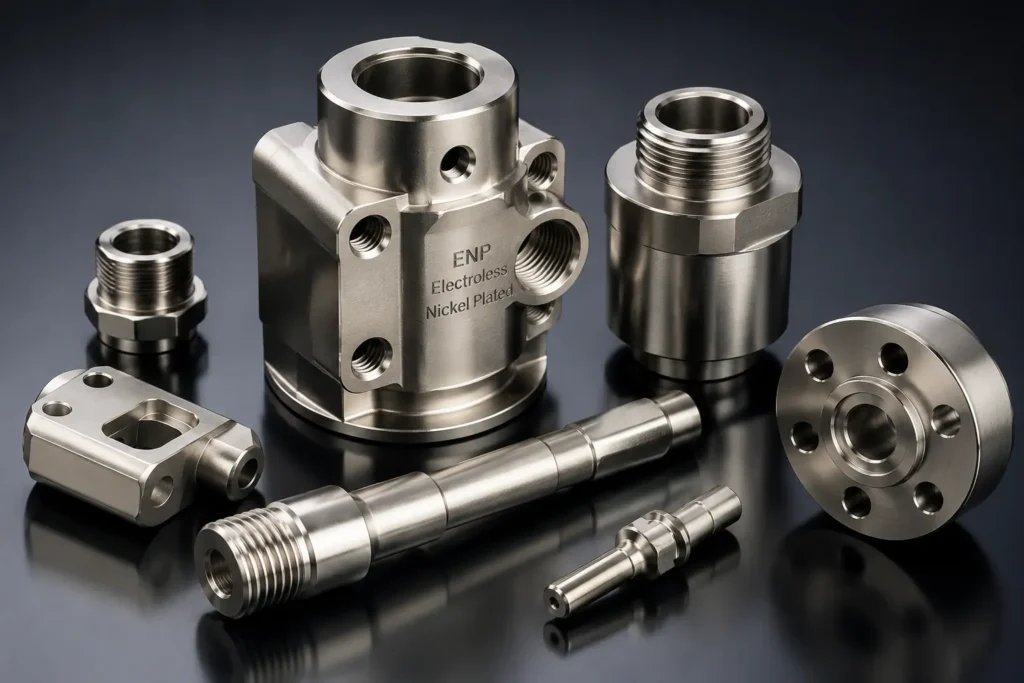
Ask a room of engineers to name the most useful metal coating in modern manufacturing, and you will get a long list: hard chrome, anodizing, zinc, powder coat. But the one that quietly shows up in more industries than almost any other is electroless nickel plating. It protects oil field valves, extends the life of aluminum aircraft components, finishes printed circuit boards, and keeps hydraulic cylinders running in farm equipment. Despite that reach, a surprising number of people who specify parts, or machine them, have only a fuzzy idea of what the process actually is.
The word “electroless” is where most of the confusion starts, so let’s clear that up first, then walk through how the process works, why it behaves so differently from conventional plating, and where it earns its keep in real applications.
The Key Difference: No External Current
Conventional nickel plating is electrolytic. The part is wired into a circuit, submerged in a metal salt solution, and current is applied. Nickel ions are driven onto the surface wherever the current flows. It works well, but the physics has a built-in limitation: metal deposits faster where current density is highest, which means edges, points, and outside corners build up thick while recesses, bores, and internal surfaces build up thin, or in deep features, not at all.
Electroless nickel plating uses no external current at all. Instead, the deposit forms through a chemical reaction. The plating bath contains nickel ions and a reducing agent, most commonly sodium hypophosphite. When a catalytically active surface enters the bath, the reducing agent reacts with the nickel ions right at the surface, and nickel metal deposits onto the part. Once the first layer of nickel forms, it is itself catalytic, so the reaction continues on its own. That is what “autocatalytic” means: the coating catalyzes its own growth.
This one difference explains nearly everything about how the process behaves and why engineers specify it.
Why Uniformity Is the Signature Advantage
Because there is no current field shaping the deposit, metal builds at the same rate everywhere the solution touches. A part with threads, blind holes, deep bores, and complex internal channels plates with essentially the same thickness on every surface, inside and out.
In practical terms, this is a big deal. An electrolytic deposit on a threaded component might be twice as thick on the crest of the thread as in the root, which distorts the thread form and complicates dimensional planning. An electroless deposit follows the geometry exactly. Designers can specify a thickness and trust that the entire functional surface carries it, which makes it possible to plate to dimensional tolerances, plating a part to bring a bore or a shaft back into spec, rather than just for appearance.
That predictability is why electroless nickel is common on precision components: hydraulic pistons, valve internals, molds, and machined parts where a uniform, thin, hard layer has to do its job without changing the part’s dimensions beyond the allowance.
The Phosphorus Question
Here is a detail that surprises newcomers: electroless nickel is not pure nickel. Because hypophosphite is the reducing agent, phosphorus co-deposits with the nickel, typically between 2 and 13 percent by weight. The phosphorus content is not an impurity to minimize. It is a design variable, and the bath chemistry is chosen to hit a target range.
Low phosphorus deposits (roughly 1 to 5 percent) are the hardest in the as-plated condition and have the best wear resistance, but the lowest corrosion resistance of the three types. They also remain slightly magnetic. Common uses include wear surfaces and components that need to be brazed or welded afterward.
Mid phosphorus deposits (roughly 5 to 9 percent) are the general-purpose workhorse. They plate bright, offer a good balance of hardness and corrosion protection, and are the most common choice for industrial components and fasteners.
High phosphorus deposits (roughly 10 percent and above) are the corrosion specialists. They are amorphous in structure, essentially non-magnetic, and offer outstanding resistance to acids and aggressive chemicals. That combination makes them the standard in oil and gas, chemical processing, and electronics applications where magnetic interference or chemical attack rules out other options.
If you take one thing away from this section, make it this: “electroless nickel” is a family of coatings, not a single one. When a drawing says EN without a phosphorus callout, the plater is left guessing what the part actually needs.
What the Coating Delivers in Service
The deposit itself is an alloy of nickel and phosphorus with a set of properties that explain its wide use.
Corrosion resistance comes from the deposit’s density and, at high phosphorus content, its amorphous structure, which lacks the grain boundaries that give corrosion a place to start. Properly applied EN on steel can pass thousands of hours of salt spray exposure.
Hardness and wear resistance are strong out of the bath, and heat treatment makes them stronger. As-plated hardness is roughly 45 to 50 on the Rockwell C scale for mid-phosphorus deposits. Baking the plated part at moderate temperature precipitates nickel phosphide, pushing hardness toward the range associated with hard chrome, with excellent wear life on sliding and rotating surfaces.
Uniformity on complex geometry, as covered above, which no electrolytic process matches.
Lubricity is a quiet bonus. The coating has a naturally low coefficient of friction, which helps on threaded parts and sliding fits.
Compatibility with many substrates is broader than most people expect. Steel, stainless, aluminum, copper alloys, and even some plastics and composites can be plated, provided the pretreatment is right. Aluminum deserves special mention: EN is one of the best ways to give lightweight aluminum parts a hard, corrosion-resistant, wear-ready surface, which is why it is everywhere in aerospace and automotive work.
The Pretreatment Reality
For all its advantages, electroless nickel has a demanding side: it will faithfully reproduce, and often highlight, whatever surface it lands on. It does not level over scratches or hide poor machining. A rough part plates rough. A contaminated surface plates badly, or not at all, or with adhesion that fails later in service.
That is why pretreatment is the heart of the process. Cleaning, degreasing, acid activation, and for aluminum, a zincating step that prepares the surface for adhesion, all have to be executed correctly. Most EN failures in the field trace back not to the bath but to inadequate cleaning or activation. When evaluating a plating supplier, their pretreatment discipline and process controls tell you more about the quality you will receive than their bath chemistry does.
Where You Will Find It
A quick tour of applications shows the range. Oil and gas components, valves, couplings, and tubular goods, rely on high-phosphorus EN against sour gas and brine. Aerospace uses it on landing gear, hydraulic components, and aluminum housings. Electronics and printed circuit boards use EN as a conductive, solderable, corrosion-resistant finish. Automotive applications include fuel system components, where the coating’s chemical resistance matters, and transmission and drivetrain parts. Molds and dies get EN for release and wear. Even the food and chemical processing industries use it on equipment that must resist aggressive washdowns.
Specifying It Correctly
If you are writing a drawing or a purchase order, a few callouts prevent most problems. Specify the thickness, typically anywhere from 0.0002 to 0.002 inches depending on the duty. Specify the phosphorus class, low, mid, or high, based on whether the priority is wear, general use, or corrosion. Specify post-plate heat treatment if maximum hardness is needed. And reference the governing standards, ASTM B733 and AMS 2404, which define deposit requirements and test methods, so the plater and the inspector are working from the same page.
The Bottom Line
Electroless nickel plating is a chemical, not electrical, deposition process that coats every wetted surface of a part at a uniform, predictable thickness. Its phosphorus content can be tuned for hardness, corrosion resistance, or non-magnetic behavior, and with heat treatment it rivals hard chrome for wear. It demands disciplined pretreatment and rewards it with a coating that protects threads, bores, and complex geometries that no electrolytic process can reach evenly. For engineers and buyers, the takeaway is simple: understand the three phosphorus classes, specify thickness and heat treatment explicitly, and choose a plater whose process control you trust. Do that, and EN will quietly solve problems on your parts for decades.